


Here we offer guidelines for writing up your assessment using the neighbourhood assessment framework.
The neighbourhood assessment triangle is based on a social-care model of assessment, where the broad goals are to find out about the safety, welfare and support needs of young people to aid response planning. Children’s social care services use a model (CAF) that was designed to assess a child’s needs within their family setting, by focusing on:
1) Child development needs
2) Family and environmental factors
3) Parenting capacity
The Contextual Safeguarding neighbourhood assessment framework translates these principles to a neighbourhood context, set out in this triangle: 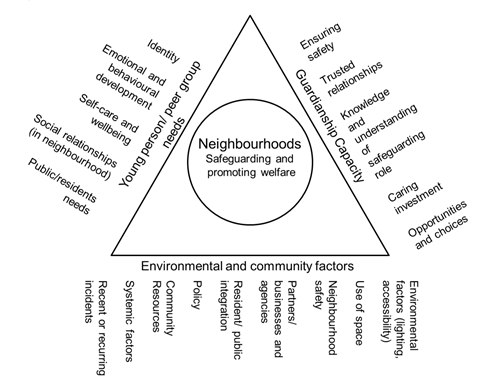
We have developed a neighbourhood-assessment form which translates this framework into prompts to support your neighbourhood assessment. Use the template form to guide your assessment of the neighbourhood. Mirroring the CAF, the purpose is to understand:
1) The strengths and needs of young people collectively in this context.
2) The availability of ‘guardianship’ in the context - i.e. adults with a caring intention who can support the wellbeing and safety of young people there.
3) The availability of resources, physical environment, policy and wider systemic features to support safety in this context.
You will then use this information to form goals which will shape the responses you deliver.
The best approach is to work through the prompts in the neighbourhood-assessment form using the information you gather through your scoping to complete the sections. You’ll then need to step back and reflect on what needs to happen in this neighbourhood to enhance the safety of young people. We recommend doing this in partnership with others, in reflective discussion, so that you have the benefit of several perspectives. You may want to use the Context Weighting tool (see below) to help you to organise your findings from the assessment and decide what is the greatest influence on harm. Finally, it will help to write this up succinctly so that your completed assessment supports you to clearly see what the issues are and develop a plan to address these.
In the carousel below there is an exemplar of a completed neighbourhood-assessment form to give you an idea of how to write this up. There is also a link to the next section ('Tools to support a neighbourhood assessment'), which outlines key tools to help you scope a neighbourhood.


