


Here we offer guidelines for writing up your assessment using the friendship and peer assessment framework.
The friendship and peer assessment framework is based on the social-care model of assessment which was originally designed to assess the needs of children within their family setting, by focusing on:
- Child development needs
- Parenting capacity
- Family and environmental factors
We have translated the original assessment framework into an equivalent for understanding the needs of a friendship group, as set out in this triangle:
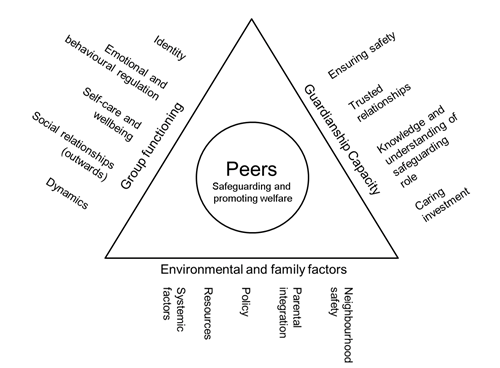
Our friendship and peer assessment template form translates this framework into prompts to support your assessment. Use the template form to guide you. The purpose is to understand:
1) Group functioning: how young people relate to each other, their identity, how they perceive themselves and how others perceive them.
2) The availability of ‘guardianship’ around the group - such as adults with a caring intention who can support the wellbeing and safety of the group. This will depend on the context in which the group is formed, for example in school or a local youth club.
3) Environmental and family factors. Which other factors affect the safety of young people? These may relate to the local neighbourhood context, the policies in place to safeguard the young person/ people, the support of their parents, or systemic and structural factors such as poverty or racism.
You will then use this information to form goals which will shape the responses you deliver.
The assessment framework is underpinned by key values and legal and ethical considerations, which are outlined in the following pages. Make sure you familiarise yourselves with these before turning to the tools that can support your assessment.